
how to dress business casual women is mostly about reading your workplace, then building a small set of reliable pieces you can mix without thinking too hard on busy mornings.
If you have ever shown up feeling overdressed in a blazer, or underdressed in denim that seemed “fine” at home, you already know why business casual feels tricky, it changes by office, role, and even city. The good news, you rarely need a huge wardrobe, you need a clear baseline and a few smart swaps.

What this guide will do is keep you out of the two most common traps, copying “corporate” looks that feel stiff, and leaning so casual that your outfit starts sending the wrong signal. You will get a quick way to judge your office, a capsule-style checklist, and outfit formulas you can repeat.
What “Business Casual” Actually Means (in Real Offices)
Business casual usually means polished, work-appropriate, and comfortable enough to move through your day, without the strictness of a full suit. But it is not a universal uniform, it is a range.
According to Society for Human Resource Management (SHRM)... many workplaces set dress expectations as part of professional conduct and culture, which is why your safest move is aligning with your specific environment, not a generic Pinterest board.
- Traditional business casual: trousers, blouses, cardigans, blazers, closed-toe flats or low heels, minimal logos.
- Modern business casual: elevated knit tops, dark denim in some offices, clean sneakers in creative teams, softer silhouettes.
- “Client-facing” business casual: closer to business professional, sharper tailoring, more structured shoes, fewer casual fabrics.
If your company uses the phrase “dress for your day,” take it literally, your outfit can shift based on meetings, presentations, and who you will be with.
Why You Feel Stuck: The Common Reasons Business Casual Gets Confusing
Most people are not confused about clothing, they are confused about expectations. Here is what tends to drive the stress.
- Mixed signals in the office: your manager dresses one way, your team dresses another, and HR language stays vague.
- Fabric and fit do more than the item: a tee can look refined in a structured knit, and sloppy in thin cotton.
- Footwear changes everything: the same pants look different with loafers versus running shoes.
- Seasonal drift: summer pushes outfits casual fast, winter adds layers that can look bulky or too formal.
Once you accept that “business casual” is more about polish than any single piece, the decisions get easier.
Quick Self-Check: What Level of Business Casual Does Your Workplace Expect?
Before you buy anything, do this quick scan. You can do it in one week.
- Look at leaders: do directors wear blazers daily, or mostly sweaters and nice jeans?
- Watch footwear: are loafers and heeled boots common, or do you see clean sneakers often?
- Notice denim: if denim shows up, is it dark, tailored, and logo-free, or relaxed and distressed?
- Track “meeting days”: does the office visually level up when clients visit or when leadership is in town?
- Read the room on skin and sheerness: strap width, hemlines, and transparency tend to be the fastest way to stand out, in a bad way.
If you still feel uncertain after observing, aim one notch more polished than the team average for your first month, it is easier to relax later than to rebuild trust after looking too casual.
The Business Casual Foundation: Staples That Do the Heavy Lifting
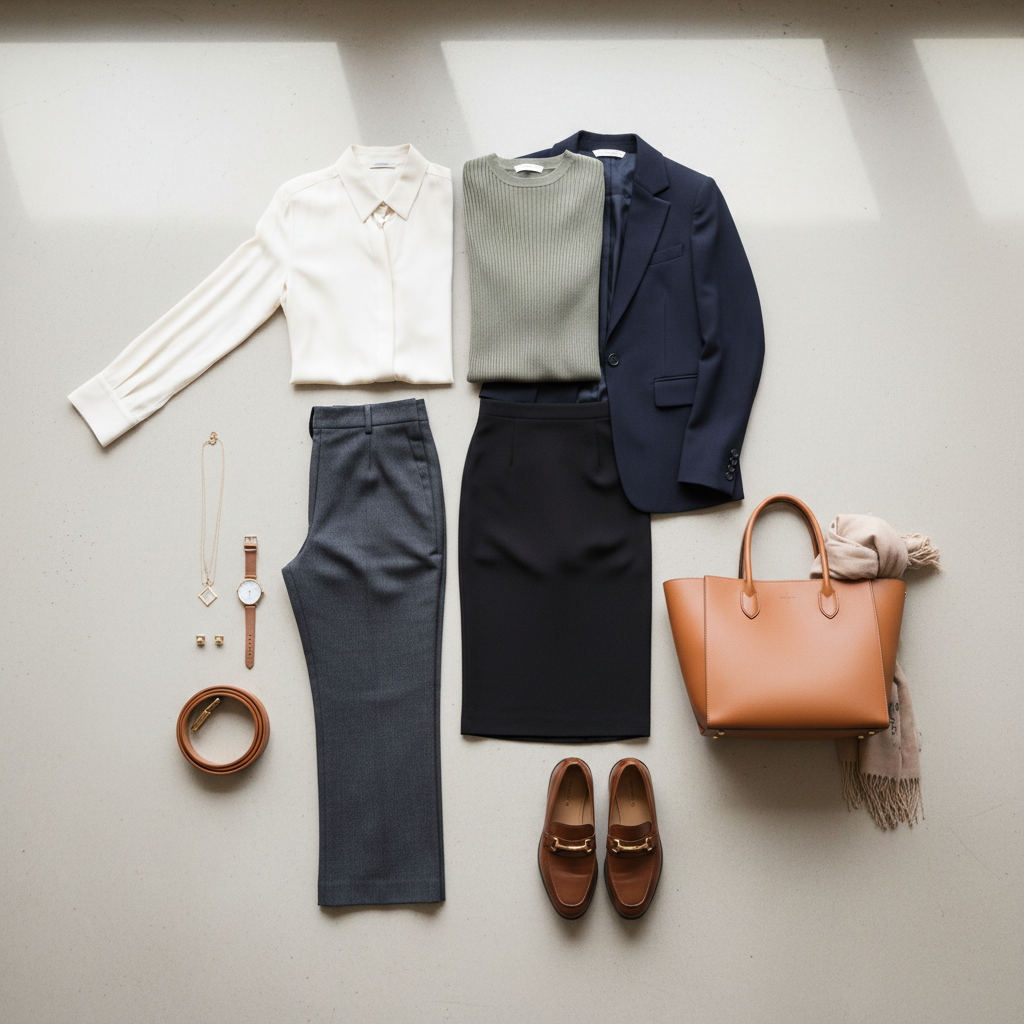
When people ask how to dress business casual women, the most practical answer is “get your base right,” because the base pieces carry most outfits.
Core tops
- Blouses and shells: matte fabrics, simple necklines, not clingy.
- Fine-gauge knits: look elevated, layer easily, photograph well on video calls.
- Button-down shirts: oversized can work, but keep it intentional with clean lines.
Core bottoms
- Tailored trousers: ankle-length or full length, mid to high rise tends to read more professional.
- Skirts: midi or knee-length is the safest default in many offices.
- Office-approved dark denim: only if your workplace clearly supports it, choose minimal wash and no distressing.
Third pieces (the upgrade lever)
- Blazer: instant structure, choose a fabric that does not wrinkle quickly.
- Cardigan or jacket: softer than a blazer, still polished if the fit is clean.
Shoes and bags
- Loafers, flats, low block heels, sleek ankle boots cover most business casual offices.
- Clean sneakers can work in modern environments, but keep them minimal and in good condition.
- Structured tote or satchel looks more “work” than a slouchy bag.
Key takeaway: if you invest anywhere, invest in fit and shoes, people notice both even when they cannot name why.
Outfit Formulas You Can Repeat (and Adjust by Office)
Formulas prevent decision fatigue. Pick two or three, rotate colors, and you are covered.
- Formula A: knit top + tailored trousers + loafers + optional blazer for meetings.
- Formula B: blouse + midi skirt + flats, add a cardigan when the office runs cold.
- Formula C: button-down + straight-leg pants + ankle boots, simple and always appropriate.
- Formula D (modern offices): elevated tee or knit + dark denim + blazer + minimal sneakers or loafers.
Color also does quiet work. Neutrals make mixing easy, but you do not need to dress in beige only, one strong color in a top or shoe can look intentional if the silhouette stays clean.
Practical Guide by Day: What to Wear When the Calendar Changes
Business casual is easier when you “dress for the room,” not just the dress code.
| Situation | Safer direction | Easy upgrade |
|---|---|---|
| First week at a new job | More polished than average | Add a blazer or structured bag |
| Client meeting or presentation | Closer to business professional | Swap flats for loafers/low heels, add simple jewelry |
| Regular internal day | Comfortable, tidy, office-appropriate | Third piece like cardigan or jacket |
| Casual Friday (unclear rules) | One casual element only | Keep the rest tailored and clean |
| Video-call heavy day | Top half reads polished | Wear a knit, blouse, or jacket in a solid color |

If you want a simple rule, keep one “casual” choice at a time, like denim or sneakers, but not both together, unless your office clearly treats that as normal.
Mistakes That Quietly Undercut a Business Casual Look
Most business casual misses are not dramatic, they are small details that stack up.
- Overly casual fabrics: thin jersey, visible sportswear materials, anything that reads like loungewear.
- Fit issues: pulling at buttons, gaping, constant adjusting, it signals discomfort and distracts.
- Too many statement pieces at once: loud print plus bold shoe plus big jewelry can feel less professional.
- Shoes that look tired: worn soles and scuffed toes can make a great outfit feel off.
- “Almost appropriate” tops: low necklines, very sheer fabrics, or cropped lengths often cause the most second-guessing.
This is also where tailoring helps. Hemming pants to the right length and adjusting waist fit usually costs less than buying new pieces, and it changes the entire impression.
When to Ask HR or a Manager (and How to Do It Without Feeling Awkward)
If your workplace has safety requirements or strict client standards, guessing can backfire. According to Occupational Safety and Health Administration (OSHA)... some workplaces require specific attire or protective gear, so business casual expectations might be limited by safety policies, in those settings it is worth confirming.
- If your team is split between very casual and very formal, ask what is expected for your role.
- If you are new, you can say, “I want to align with the team standard, is dark denim acceptable here, or should I stick with trousers?”
- If you are client-facing, ask what “meeting day” attire looks like in your department.
If you are dealing with body-related fit challenges or comfort issues, a stylist or tailor might be more helpful than buying random pieces online, and you do not need a big budget for one good fitting session.
Conclusion: A Simple Way to Feel Confident in Business Casual
When you are figuring out how to dress business casual women, focus on polish, fit, and consistency, then adjust up or down based on the people you work with and the meetings you take. You do not need dozens of outfits, you need a few formulas that work and a clear sense of what your office rewards.
Action steps: pick two outfit formulas from this guide, build them with pieces you already own, then identify the single gap that would make mornings easier, usually shoes, trousers, or a third piece like a blazer.
FAQ
How do I know if jeans count as business casual for women?
If jeans show up often in your office, especially on leaders or client-facing coworkers, dark, tailored denim may fit. If denim appears rarely or only on Fridays, keep jeans as an occasional option and choose trousers most days.
Can I wear sneakers in a business casual office?
Sometimes, yes, but the sneaker has to look intentional, clean, minimal branding, and paired with structured pieces like trousers or a blazer. Athletic running shoes usually push the outfit into casual territory.
What is the easiest way to make business casual look more professional?
Add structure with a blazer, a structured bag, or a shoe upgrade like loafers. Those three changes often shift the whole outfit without changing your comfort level.
How many business casual outfits do I actually need?
Many people do fine with 8 to 12 mix-and-match pieces, a few tops, two to three bottoms, two layering pieces, and two pairs of office-appropriate shoes. The right color palette makes the small wardrobe feel bigger.
Are sleeveless tops business casual for women?
In many offices, sleeveless can work if the neckline is modest and the fabric is not sheer, but it depends on company culture. Keeping a cardigan or blazer nearby is a simple backup plan.
What should I wear for a business casual interview?
Aim slightly more formal than daily office wear, tailored pants or a knee-length skirt, a blouse, and a blazer or structured cardigan. It is safer to look polished, then adapt once you learn the culture.
How can I dress business casual in summer without feeling too casual?
Choose breathable but polished fabrics like cotton poplin, linen blends, or lightweight knits, and keep silhouettes structured. Sandals can be tricky, so closed-toe flats or loafers often feel more reliably office-ready.
What colors work best for business casual outfits?
Neutrals like navy, black, gray, and cream mix easily, then you can add one accent color in a top, scarf, or shoe. If your office is conservative, keep brighter colors in solid blocks rather than loud prints.
If you are trying to build a business casual wardrobe fast for a new job or a role change, it may help to start with two weeks of repeatable outfits, then fill gaps based on what your office actually wears, not what the internet says you should.