
Women jewelry organizer tray options can feel deceptively simple until you’re staring at tangled chains, missing earring backs, and a dresser top that never looks “finished.” The right tray doesn’t just hold jewelry, it shortens your morning routine and protects pieces from scratches and accidental drops.
Most people buy a tray based on looks, then realize the compartments don’t match how they actually wear jewelry. Rings pile up, hoops snag, bracelets drift, and suddenly you’re back to using a random bowl. The good news is that choosing well is mostly about a few practical decisions: layout, lining, footprint, and where it will live on your dresser.
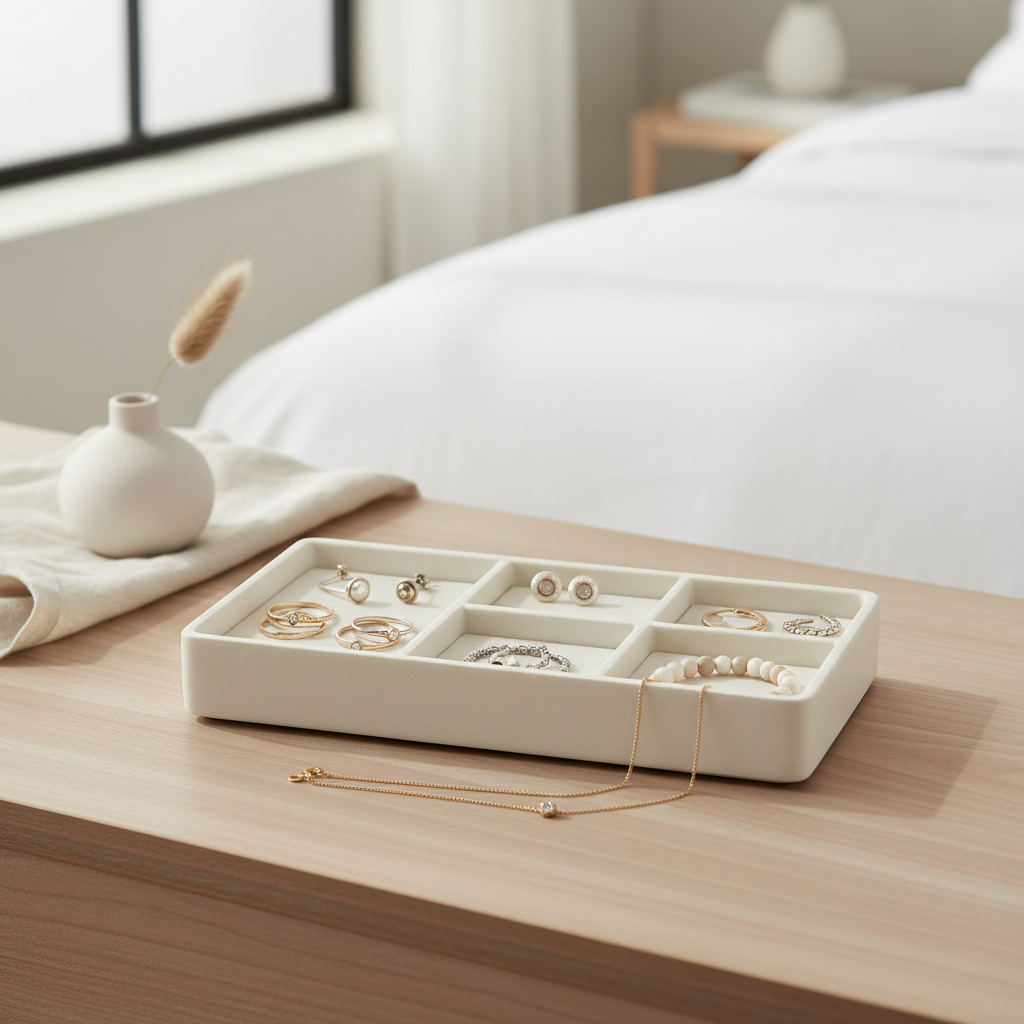
This guide breaks down why dresser trays get messy, how to tell what type you need, and which features matter more than trendy materials. I’ll also share a quick setup routine that keeps things tidy without turning jewelry care into a “project.”
Why dresser-top jewelry gets messy (and why trays sometimes fail)
If your jewelry tray looks chaotic within a week, it’s usually not a discipline problem, it’s a design mismatch. A tray has to match your habits, not an ideal version of them.
- You rotate pieces often: daily swaps create piles unless there’s a clear “home” for each category.
- Necklaces need separation: chains overlap fast, and once they knot, you stop wearing them.
- Small parts go missing: earring backs and tiny studs disappear in open compartments.
- Wrong tray depth: too shallow means items slide, too deep means you can’t see what you own.
- Slippery surfaces: unlined wood, acrylic, or metal can let pieces drift and pick up scratches.
According to the Gemological Institute of America (GIA), jewelry storage should help prevent scratches by keeping pieces separated and protected from impact. That’s the practical reason compartments and soft lining matter, even if you’re not storing fine jewelry.
A quick self-check: what kind of jewelry tray do you actually need?
Before shopping, take two minutes and answer this like you’re describing your real morning, not your Pinterest dresser.
- What do you wear 5 days a week? rings, studs, hoops, watch, layered necklaces, bracelets?
- Do you remove jewelry at the dresser or in the bathroom? location changes what “convenient” means.
- Do you own more than 3 necklaces you actually wear? if yes, you need a plan for chains.
- Do you travel often? you may want a removable mini tray or lidded insert.
- Do you have pets or small kids? open trays can become “sparkly targets,” a lid may be worth it.
If you’re not sure, default to a modular women jewelry organizer tray set, because you can reconfigure compartments when your collection changes.
Key features that make a women jewelry organizer tray work on a dresser
A tray can be pretty and still be annoying. These features tend to separate “looks nice” from “stays useful.”
Compartment layout (the real deal-breaker)
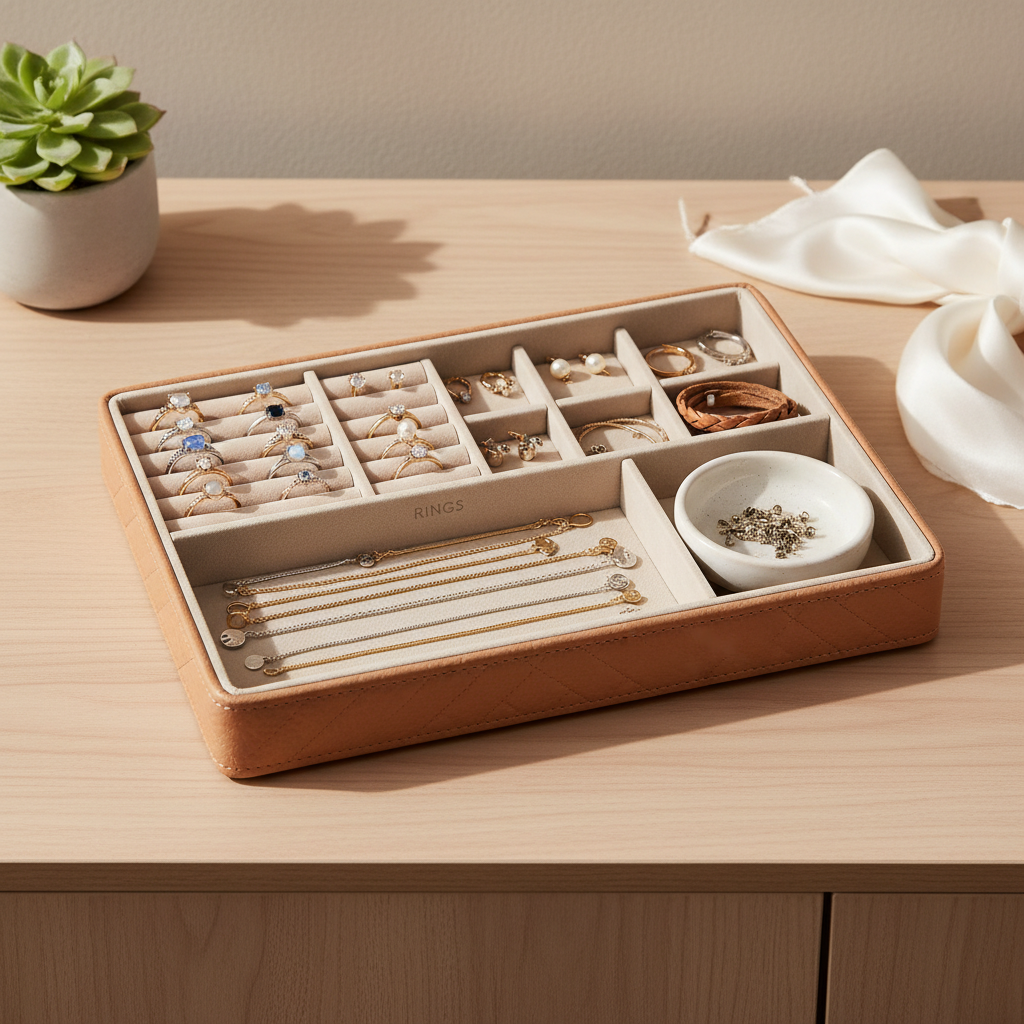
- Ring rolls for rings and small hoops, they keep shapes visible and stop rolling.
- Long slots for bracelets and watches, especially if you hate stacking.
- Micro sections for studs and backs, so tiny pieces don’t migrate.
- A landing zone for “today’s set,” a larger open compartment helps you reset quickly.
Lining and surface protection
Velvet or felt lining reduces sliding and lowers scratch risk. Faux leather can wipe clean more easily, but check that it’s not overly slick. If you store pearls or delicate plated items, gentler lining tends to be less abrasive in many cases.
Size, footprint, and stacking
Dresser space is finite. A wider tray looks luxurious, but it becomes a magnet for clutter. If your dresser is small, a stackable set often works better than one oversized organizer.
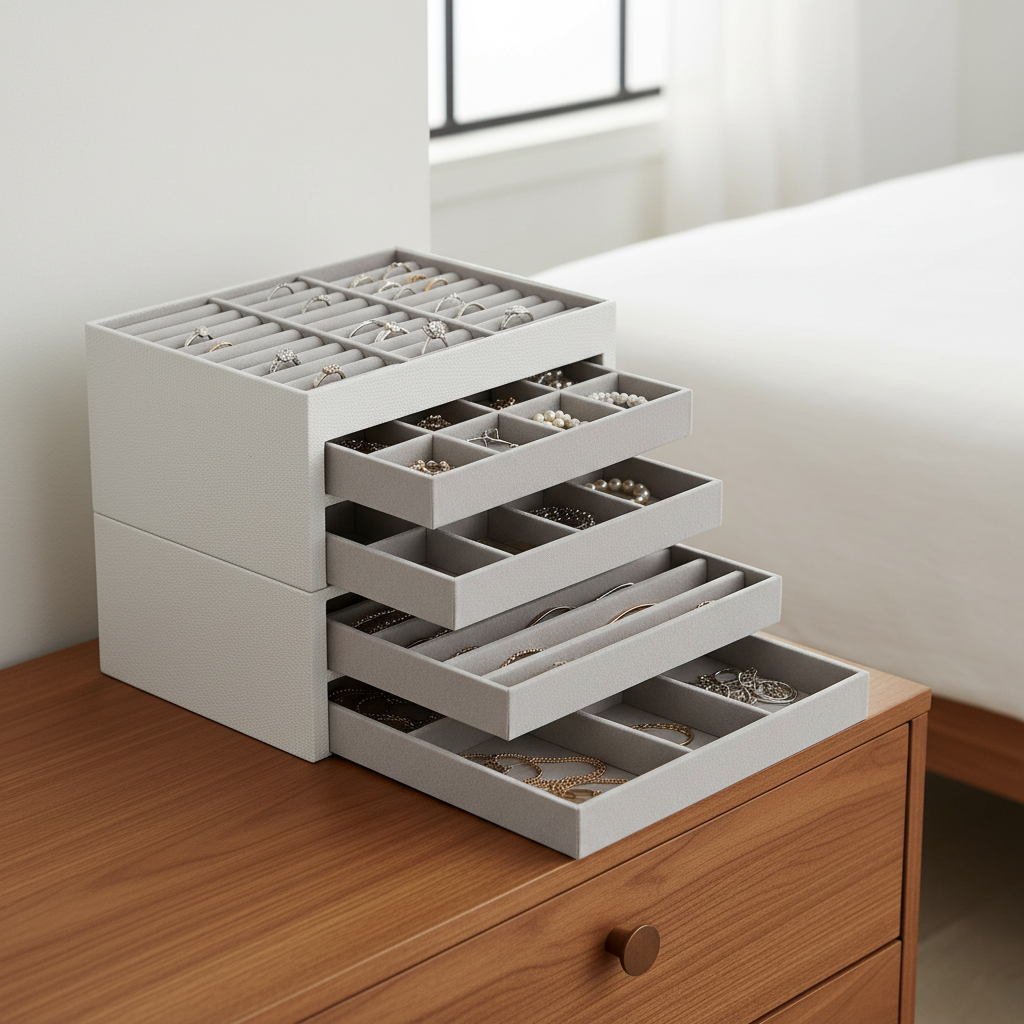
Materials (what matters, what’s mostly aesthetic)
Acrylic shows everything but can look messy fast. Wood feels warm but needs lining to protect jewelry. Metal frames can be sturdy but may snag delicate chains if edges aren’t smooth. In practice, build quality and interior finish matter more than the headline material.
Comparing common tray types (and who they fit best)
Here’s a simple comparison to help you narrow options without overthinking it.
| Tray type | Best for | Pros | Potential downsides |
|---|---|---|---|
| Open compartment tray | Minimal daily jewelry | Fast access, easy styling | Dust, pets, pieces can drift |
| Sectioned tray with ring rolls | Rings + earrings heavy | Great visibility, less mixing | Less flexible for chunky items |
| Stackable modular set | Growing collection | Expandable, cleaner look | May slow “grab and go” |
| Lidded tray (glass/solid top) | Dust control, pets/kids | Protection, calmer dresser | One extra step every day |
| Valet tray style | Nightstand use, essentials | Simple drop zone | Not enough separation for chains |
How to set up your dresser tray so it stays tidy
The setup matters as much as the tray. If you do this once, upkeep becomes almost automatic.
- Step 1: Choose a “daily core” zone, put the pieces you wear most in the easiest-to-reach compartments.
- Step 2: Separate chains on purpose, give necklaces a long channel, and avoid stacking multiple chains in a single square.
- Step 3: Create a small “reset” pocket, one open section for end-of-day drop-off prevents scatter across the dresser.
- Step 4: Keep a tiny dish for backs, if your tray lacks micro slots, add a mini insert cup.
- Step 5: Cap the capacity, if one compartment overflows, it’s a signal to edit or expand, not cram.
If you wear fragrance or hair products at your dresser, place the organizer tray a little farther from sprays. According to the American Academy of Dermatology Association (AAD), fragrances can trigger skin irritation for some people, and overspray landing on jewelry can also leave residue you’ll end up cleaning later.
Mistakes that make jewelry trays feel “useless” after a month
This is where most dresser setups quietly go off the rails. The fixes are simple, but you need to notice the pattern.
- Using one big compartment for everything: it turns into a junk drawer with better lighting.
- Storing tangled necklaces and hoping later-you deals with it: later-you usually won’t, and those necklaces stop getting worn.
- Mixing “wear now” with “sentimental”: keep special pieces separate so daily access stays fast.
- Choosing a tray only for aesthetics: if the layout doesn’t match your jewelry types, it won’t stick.
- Ignoring cleaning needs: porous liners can hold makeup residue, a removable insert can help.
Key takeaway: a women jewelry organizer tray should reduce decisions, not create new ones.
When to consider extra help: repairs, appraisal, or specialty storage
A tray solves everyday organization, but some situations call for more caution.
- Heirloom or high-value items: consider a locked case or safe storage, and keep only daily pieces on the dresser.
- Broken clasps or loose stones: stop wearing the piece and ask a reputable jeweler to check it, a quick inspection can prevent loss.
- Metal allergies or skin irritation: if jewelry causes reactions, it may help to speak with a dermatologist for personalized guidance.
- Pearls and delicate materials: they often benefit from gentler, separated storage rather than mixed compartments.
Conclusion: a calmer dresser starts with a tray that matches your routine
If your dresser is where you begin and end the day, the organizer tray is basically a tiny system. Pick a layout that reflects what you wear most, prioritize separation for chains and small parts, and give yourself a simple reset zone so clutter doesn’t spread.
If you want one action that pays off immediately, do this tonight: set up your tray into rings, earrings, bracelets/watches, and today’s landing spot, then remove anything you rarely wear from the surface. Tomorrow morning feels noticeably smoother.
FAQ
What size women jewelry organizer tray works best for a dresser?
In many bedrooms, a medium tray that holds daily pieces without encouraging “everything storage” works best. If you keep buying larger, clutter tends to expand to fill the space, so measure your usable dresser area and leave breathing room for a lamp or skincare.
How do I stop necklaces from tangling in a dresser tray?
Give each chain its own long channel when possible, and avoid layering multiple necklaces in a single square compartment. If your tray can’t do that, a small necklace stand nearby can complement the tray instead of forcing it to do everything.
Is velvet lining safe for all jewelry?
Velvet is usually gentle and helps reduce sliding, but “safe” can vary by item. Very delicate surfaces or pieces with protruding prongs can still snag on some fabrics, so if you notice catching, switch that compartment to a smoother liner.
Should I choose acrylic or wood for a jewelry organizer tray?
Acrylic makes it easy to see everything, which can be great if you forget what you own. Wood feels warmer and hides visual clutter better, but it typically needs a quality liner; without it, pieces can scratch or slide more.
How often should I clean my jewelry tray on the dresser?
A quick shake-out or wipe every couple of weeks keeps dust and makeup residue from building up. If you apply makeup at the dresser, you may need more frequent wipe-downs, especially for lighter liners.
Can I keep fine jewelry on my dresser top?
Many people do, but it depends on your household and risk comfort level. For high-value items, it may be smarter to store them more securely and keep only daily-wear pieces in the tray.
What’s the easiest way to organize earrings in a tray?
Use small compartments for studs and backs, and reserve one section for pairs you wear most. Hoops and small huggies do well in ring rolls because they stay upright and easy to grab.
Soft suggestion
If you’re rebuilding your dresser setup and want something that looks clean but also handles real-life habits, consider a women jewelry organizer tray with modular inserts and a lined surface, it’s often the simplest route for staying organized without constant re-sorting.